

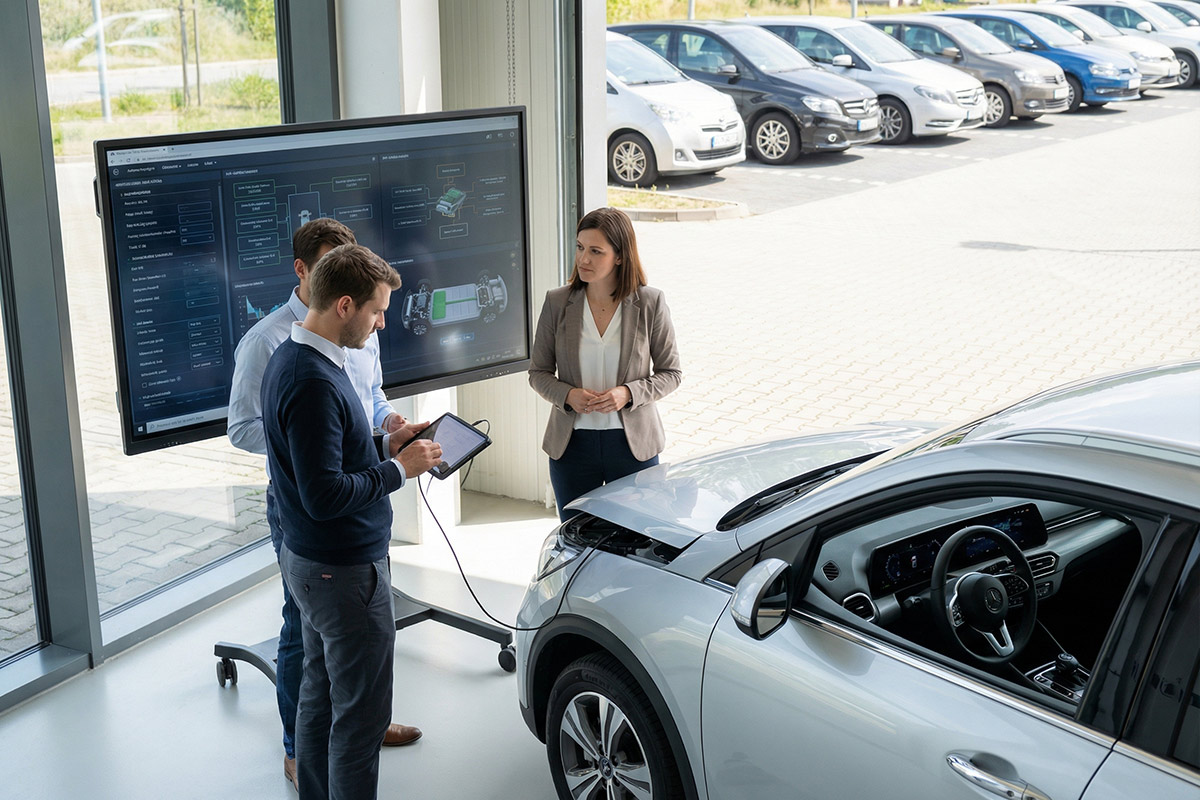
A future-proof technology stack is one that is designed to handle technological shifts, changes in vehicle models, and long-term business growth without requiring expensive, disruptive overhauls. For a car sharing operator, selecting this kind of flexible and reliable technology is one of the most important decisions you will make. It dictates your system’s uptime, your ability to integrate new vehicle types, and your ultimate return on investment (ROI).
In a service-based business like car sharing, your core technology (Telematics, Software and APIs) is the central engine of your operation. Choosing a solution that addresses immediate needs while anticipating future challenges will safeguard your fleet and your business model for years to come.
This lesson will guide you through the key considerations for selecting technology that will sustain your business, protect your investments, and allow you to scale effortlessly in a rapidly changing industry.
Build on a Reliable Foundation
The most immediate threat to your business is downtime caused by unreliable technology. When a vehicle's connectivity is lost or its onboard unit fails, the car cannot be rented, leading to lost revenue and customer frustration. A future-proof foundation begins with choosing robust hardware and stable software that are specifically engineered for the demanding environment of shared mobility.
Thinking long-term means anticipating system-wide changes, such as the widely documented 3G network shutdown. This event illustrated the critical importance of selecting telematics that supports current and next-generation connectivity standards, like 4G and 5G. For example, Flexicar from Australia was running on a system operated on a 3G network. Once the 3G shutdown was announced, they started searching for alternatives and moved to INVERS. The new technology was capable of modern connectivity standards and allowed for further scaling.
"This new system has future-proofed our entire brand."

Scott
Flexicar
Source: INVERS Success Story with Flexicar
Operators who failed to plan for this shift were suddenly forced to replace entire fleets of telematics units, incurring massive, unplanned costs and operational disruption. Your foundation must also be built on a platform that is designed to minimize risk. For example, a reliable provider can offer services like asset protection which goes beyond simple tracking by ensuring the immediate disabling of a vehicle if an unauthorized attempt is made to move it. This kind of built-in security and reliability is the cornerstone of a system that can withstand the test of time and market changes.
Choose Tech That Grows With You
One of the biggest mistakes a growing car sharing operator can make is choosing a technology that is adequate for a small pilot but cannot handle significant growth. Scalability is the essential measure of a future-proof tech stack. When you are ready to expand from 10 to 100 or 1,000 vehicles, your technology partner should enable, not limit, that growth.
The right technology allows you to add vehicles, users, and even new cities without a complete overhaul of your core systems. Ask yourself if the proposed technology is only designed for today’s operation or if it can handle tomorrow’s scale. A truly future-proof system will offer consistent performance and stability whether you are managing a neighborhood fleet or a multi-country enterprise. Look for a partner whose technology has been proven to support significant expansion, demonstrating their ability to grow alongside your business without suffering technical debt or performance issues.
Source: Insights Interview on Station-Based Car Sharing with Hertz 24/7
Prepare for Evolving Vehicle Technology
The pace of innovation in the automotive world is accelerating, making it difficult to predict what new standards will emerge. A future-proof tech stack must be vehicle-agnostic, meaning it can easily integrate with new vehicle models and technologies without requiring proprietary, custom-built solutions for every new car you add to your fleet.
As manufacturers open up their vehicle data through APIs, your technology needs to be flexible enough to handle this new method of communication alongside traditional telematics.
Source: INVERS Success Story with GoMore
Furthermore, new standards in vehicle communication, such as CAN FD (Controller Area Network Flexible Data-rate) and Automotive Ethernet, are already replacing older protocols. Your telematics unit must be powerful and sophisticated enough to process these increased data rates and new communication methods. The last thing you want is a core technology that becomes obsolete because it cannot "speak" to the latest car models. By choosing a partner with an established record of adapting to new cars, you ensure your fleet can evolve as quickly as the automotive industry itself.
Select an Expert Partner, Not a Provider
The relationship with your technology vendor is as critical as the technology itself. You must find an expert partner, not just a transactional provider. A true partner acts as an enabler and a resource, offering deep industry knowledge and support that extends beyond the telematics unit or the software platform.
When assessing a potential partner, evaluate their long-term commitment and market stability. The risk with startups is that they may pivot away from the car sharing market or be forced to close branches, leaving you without necessary support or product updates. Similarly, while a large corporation might seem stable, a focused company with decades of experience in the shared mobility space might offer more dedicated expertise and less risk of their division being deprioritized.
A true expert partner understands not only the technology but also the regulatory environment you operate in, helping you navigate complex local regulations and market shifts. They should offer proactive advice, not just reactive fixes. Your partner's expertise should act as a critical extension of your own team, ensuring your tech stack remains relevant and supported through inevitable changes.
Your Future-Proofing Checklist
Making a future-proof technology choice comes down to asking the right questions. Use this checklist of key points to evaluate potential technology partners and ensure you are building a resilient foundation for your car sharing business:
-
Longevity and Stability:
Is the company a dedicated specialist in shared mobility, and do they have a proven track record of supporting customers for five years or more? -
Hardware Agility:
Does their telematics hardware support current (4G) and future (5G) cellular connectivity standards, preventing a repeat of the 3G shutdown cost? -
Vehicle Compatibility:
Can their platform integrate with diverse vehicle types-including electric vehicles (EVs) and models using new communication like CAN FD-or is it limited to a few specific manufacturers? -
Scalability Proof:
Can the technology seamlessly scale from a small pilot fleet (e.g., 20 vehicles) to a major multi-city operation (e.g., 1,000+ vehicles) without requiring a core system migration? -
Support and Partnership:
Do they offer proactive, in-house expertise on topics like regulatory compliance and market best practices, or are they simply a hardware vendor? -
Data Security:
What dedicated services do they offer for asset protection and vehicle security beyond simple GPS tracking?
By prioritizing these factors, you move beyond short-term fixes and select a technology that is truly designed to last