

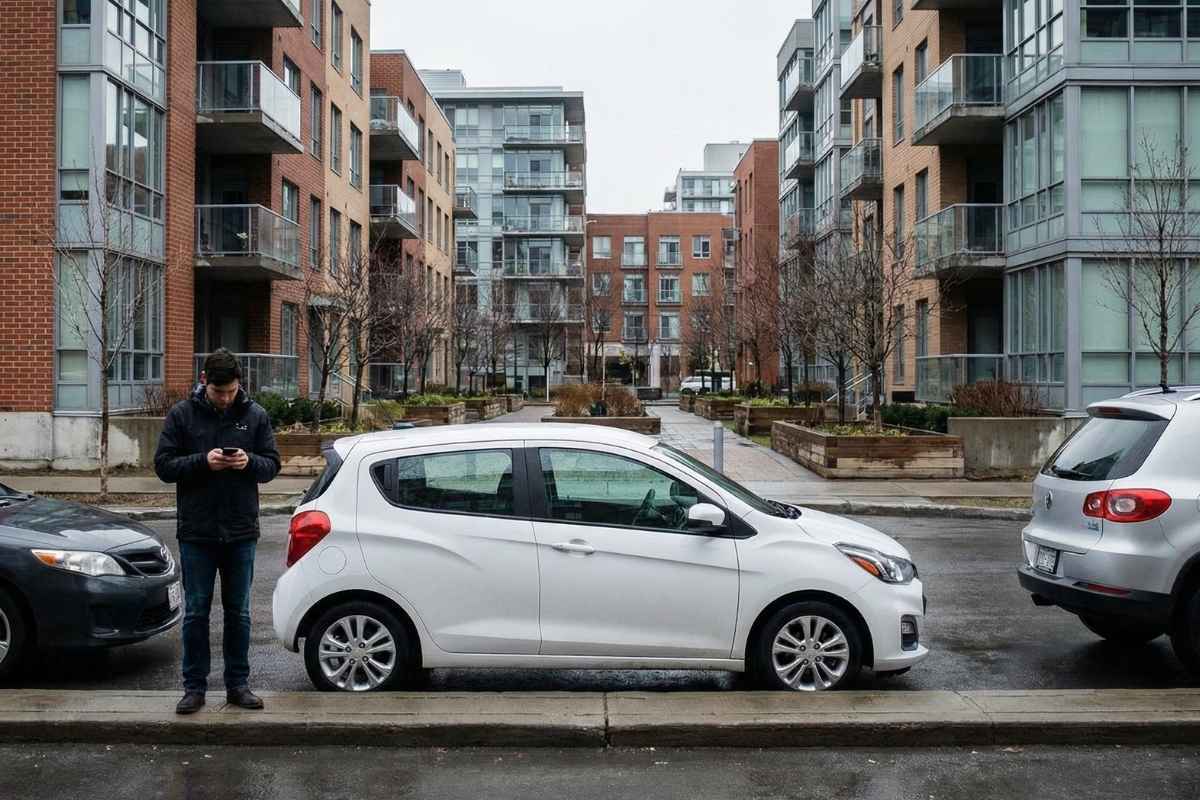
Free-floating car sharing is a dynamic business model that has transformed urban mobility by giving customers the freedom to pick up a vehicle and drop it off anywhere within a pre-defined business zone. Unlike services that use fixed stations, this model allows users to find and leave vehicles where it's most convenient, making it a highly flexible option for modern city dwellers.
By the end of this lesson, you will gain a clear understanding of this business model. We will explore what free-floating car sharing is and how it operates, its key benefits for both customers and operators, the common operational challenges you will face, and the future trends shaping this exciting industry.
Defining Free-Floating Car Sharing
Free-floating car sharing is a business model where vehicles are not tied to fixed stations. Instead, operators define a specific geographic area, often called a business zone, where customers can start and end their trips. This provides a high degree of flexibility, allowing for spontaneous, one-way journeys that match the dynamic needs of urban life.
The user experience is designed to be seamless and app-driven. A customer simply opens the service’s mobile app to locate a nearby vehicle on a map. After reserving a car, they walk to it and unlock it using their smartphone. The drive can be as short as a few minutes or longer, depending on their needs.
To complete the trip, the user parks the car in any valid parking spot within the designated business zone and ends the rental through the app. The vehicle then becomes immediately available for the next customer, creating a continuous flow of shared resources throughout the city.
Key Differences from Other Models
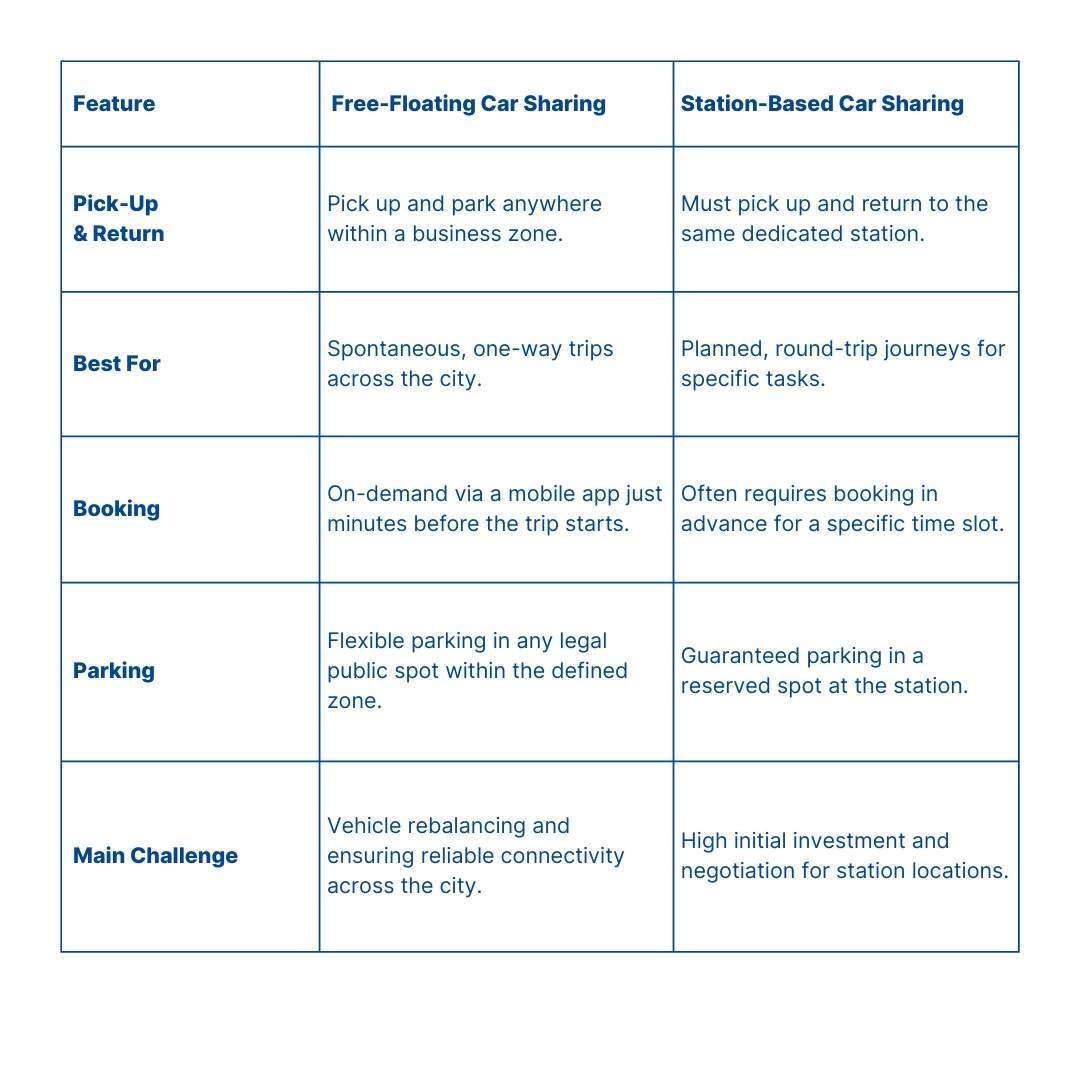
To understand where free-floating fits into the mobility landscape, it helps to compare it directly with station-based car sharing. While both are forms of car sharing, they serve different customer needs and present different operational considerations for the entrepreneur. The primary difference lies in the handling of vehicle pick-up and return locations.
The table below highlights the key distinctions between the two models.
Benefits of Free-Floating Car Sharing
The free-floating model offers powerful advantages for both the people using the service and the companies operating it. These benefits are central to its popularity in dense urban areas.
For users, the greatest benefit is convenience. The ability to start and end a rental almost anywhere makes it the most flexible form of car sharing. It is ideal for spontaneous, one-way journeys, removing the need to plan a return trip to a specific starting point. A completely digital process, from finding a car to unlocking it with a smartphone, helps ensure a smooth, frustration-free customer experience.
For operators, this model can lead to higher vehicle utilization. Because cars can be rented again shortly after a trip ends, they are used more frequently than vehicles that must wait at a station. The technology needed for a free-floating service also provides rich data, offering insights that help operators optimize vehicle usage and make informed business decisions.
Finally, the model allows for more streamlined scaling, as new vehicles can be added to the fleet without the cost and logistics of securing new station locations.
Common Challenges in Free-Floating Operations
The flexibility of free-floating car sharing creates unique operational challenges. Vehicles naturally follow commuter patterns, accumulating in business districts during the day and residential areas at night. This requires active fleet rebalancing. Operators often use a dedicated team to relocate vehicles or offer incentives, like driving credits, to users who move cars from low-demand to high-demand zones.
Securing parking permissions is another significant hurdle. The flexibility for users to park in most legal spots requires complex agreements with municipalities. Operators must negotiate permits to allow their fleet to use public parking without individual payment for each trip or to manage restrictions like "Residents Only" parking. Maintaining these permits is vital, so the service must be viewed as a community asset, not a nuisance.
Oftentimes, cities will not grant blanket permission to park anywhere but omit certain areas. For example, they might prefer your vehicles to stay out of narrow, old town streets. In other cases, you may want to block certain areas of the business area. Some semi-public areas may be closed off in the evening, and you do not want your vehicles to get stuck, or your vehicles get towed too often when they are parked in a certain street.
In all these cases, finely configured geofences are the best solution. Every single boundary should be set accurately. Quickly drawn business areas may lead to streets being cut in half, areas being omitted that you wanted to include, or vice versa. In general, it is a good practice to extend your geofences a few meters beyond your defined business area to account for inaccurate GPS positions, for example under bridges or in urban canyons.
Maintenance and cleaning are also more difficult because vehicles are dispersed. This requires a mobile service team, to handle routine tasks on the ground. These teams perform periodic cleaning, conduct basic checks, and move vehicles to workshops for scheduled maintenance like an oil change.
Finally, managing energy levels differs greatly for gasoline cars versus electric vehicles (EVs). Charging an EV is complex because it takes too long to be practical during a short rental.
Other emerging solutions include using EVs with larger batteries that last a full day after an overnight charge or innovative technologies like battery swapping.
The Future of Free-Floating Mobility
The future of free-floating car sharing is bright, with several key trends driving its evolution and deeper integration into city life. For operators, staying aware of these trends is essential for long-term success.
First, the shift toward electric vehicle (EV) fleets is accelerating. This aligns with sustainability goals but adds the operational complexity of managing charging for a distributed fleet. Second, free-floating services are becoming a critical component of Mobility as a Service (MaaS) platforms. This integration offers users a seamless way to combine car sharing with public transport in a single app.
Finally, the use of data analytics will become even more central to operations. Operators increasingly use data to make informed business decisions, from setting dynamic prices to predicting maintenance needs and understanding usage patterns to optimize the customer experience.
Key Takeaways
What is free-floating car sharing?
Free-floating car sharing allows users to pick up and drop off vehicles anywhere within a defined business zone, offering maximum flexibility.
How does free-floating car sharing work?
The service is app-based, allowing users to locate, book, and unlock vehicles spontaneously for one-way trips.
Why should I consider a free-floating model?
Users gain significant convenience, while operators can achieve higher vehicle utilization and scale their business without the need to build physical station infrastructure.
What are the main challenges of operating a free-floating service?
Major operational hurdles include fleet rebalancing, securing city parking permits, mobile maintenance and cleaning, and managing the unique complexities of EV charging.
How will free-floating car sharing develop?
The model is set for continued growth, driven by the shift to electric vehicles, integration into MaaS platforms, and increasingly sophisticated data-driven operational improvements.